At an Indian business lunch, the meal may arrive as a shared spread rather than a sequence of Western-style courses. Indian dining etiquette for a business lunch is simple to approach: follow the host’s lead, choose hands or cutlery neatly, and take food from shared dishes with care. You don’t need to know every custom in advance to show respect at the table.
It’s natural to wonder whether to reach for a fork, when to begin, or how to respond when your host offers more. These moments are easier to navigate when you know common cues, while remembering that customs can vary from one table to another.
Here’s how to choose between hands and utensils, share food hygienically, compliment your host, handle extra servings, and follow the meal’s flow. With these cues in mind, you can relax and focus on the conversation and the food.
Key Takeaways
- Let the host’s lead and the food itself guide whether you use your hands or cutlery.
- Offer a sincere, specific compliment to show appreciation for the meal.
- Take modest portions, finish what you serve yourself, and politely decline more if you’re full.
- Use serving utensils or a clean hand for shared dishes, and take food from the communal dish rather than another guest’s plate.
- Expect dishes to arrive together, then follow the host’s cues about when to begin and how the meal unfolds.
1. Choosing whether to use cutlery or hands
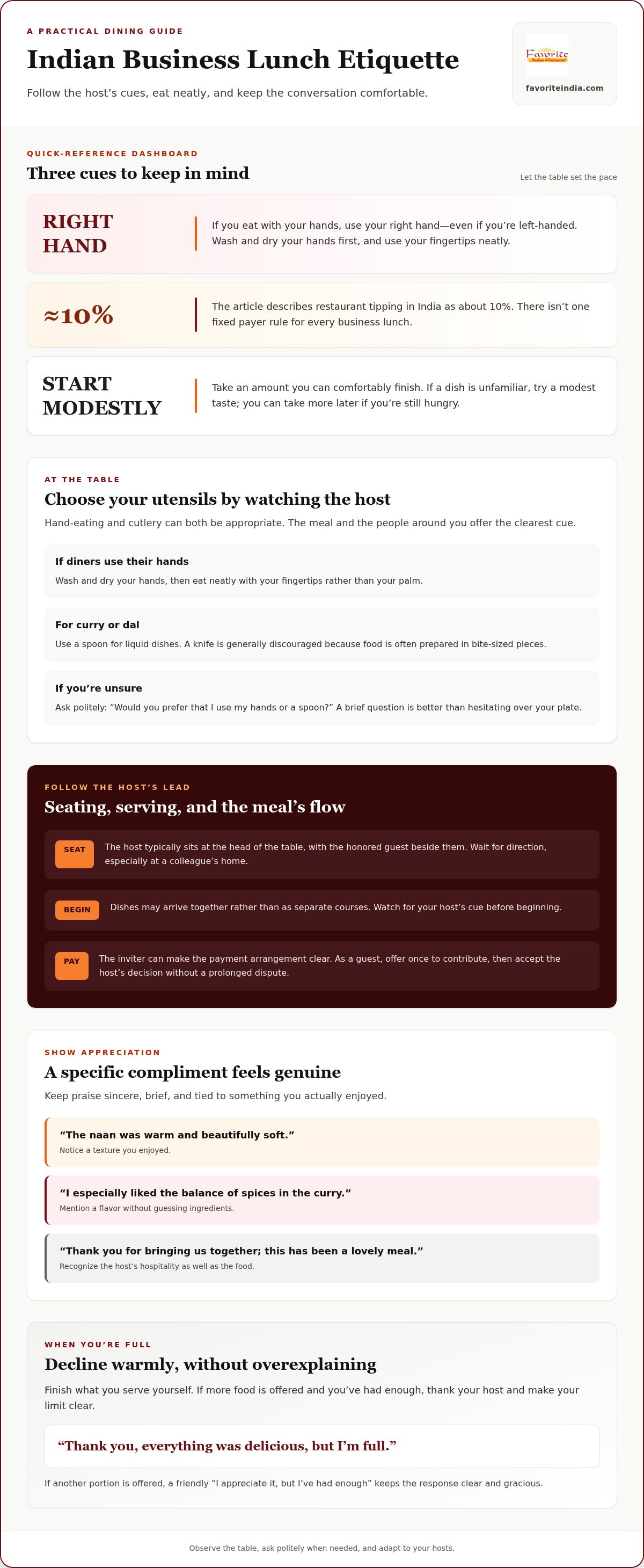
For an Indian business lunch, follow the host’s example and the way the food is served. If diners use their hands, eat with your right hand, even if you’re left-handed. Wash and dry your hands before eating, then use your fingertips neatly rather than your palm.
Traditional meals may be eaten by hand, while cutlery is also common in modern restaurants and formal gatherings. Watch how your host and colleagues begin. If you’re unsure, ask, “Would you prefer that I use my hands or a spoon?” A brief question is more graceful than hesitating over your plate.
Use a spoon for liquid dishes such as curry or dal, which are commonly eaten with spoons in Indian urban homes and restaurants. Food is often prepared in bite-sized pieces, so a knife is generally discouraged. If a fork helps, right-handed diners can keep the spoon in the right hand and switch hands to use the fork.
Choose neat business attire suited to the invitation and restaurant. A collared shirt with tailored trousers, or an equally polished outfit, makes a professional impression. Keep your clothes clean and comfortable for a seated meal.
Greet colleagues warmly, then introduce yourself with your name and role. For example, say, “Good afternoon, I’m Maya Patel, and I work with the operations team.” Use the names and forms of address your hosts offer.
At a business meal in India, the host typically sits at the head of the table, with the honored guest beside them. Wait for your host to direct you, especially at a colleague’s home, rather than choosing a seat unprompted.
Mention dietary restrictions before ordering or serving yourself, and explain what you need clearly. Keep religious dietary practices in mind: Muslims avoid pork, while Hindus do not eat beef. Alcohol preferences vary, so don’t assume a colleague drinks. Follow their lead and choose a nonalcoholic drink if preferred.
There isn’t one fixed payer rule for every business lunch. The inviter can make the arrangement clear; as a guest, offer once to contribute, then accept the host’s decision without a prolonged dispute. Restaurant tipping in India is described as about 10 percent.
Regional customs and restaurant settings can shape a meal, so treat local cues as more useful than assumptions. A formal dining room, a colleague’s home, and a casual city restaurant may feel different. Observe your hosts, ask politely when needed, and adapt to the table.
2. Complimenting the cook or host
After an Indian meal, compliment your host on the food. Keep your praise sincere and specific. “The naan was warm and beautifully soft” tells the host what you enjoyed. “I especially liked the balance of spices in the curry” adds a thoughtful detail without exaggeration.
Choose a moment when your host can hear you without interrupting a conversation. A natural pause near the end of the meal works well, or mention a favorite dish as it’s served. For example, say, “That samosa has a lovely crisp texture,” then return your attention to the table.
A compliment can recognize hospitality as well as cooking. If your host arranged the lunch, you might say, “Thank you for bringing us together; this has been a lovely meal.” That acknowledges their welcome without assuming they prepared every dish themselves.
In a business setting, keep your wording warm and professional. Avoid turning praise into a speech, comparing the meal with other restaurants, or calling a dish your favorite if you haven’t tried it. A short, honest remark feels more personal than broad praise such as “Everything is perfect.”
Use sensory details you can genuinely identify: a crisp pakora coating, tender kebabs, fragrant rice, or creamy curry. If you’re unsure about an ingredient, praise the flavor or texture instead of guessing. “The sauce is rich and balanced” is safer than naming spices you can’t recognize.
If your host asks what you enjoyed, name a dish and explain why. “I liked the butter chicken because the sauce was smooth and savory” gives a clear answer. You can also mention how a dish paired with naan, if that reflects what you actually tasted.
If the cook is present, offer your compliment briefly and politely. If your host passes along your praise, accept that graciously rather than insisting on a longer exchange. The aim is to show appreciation, not put anyone on the spot during a professional lunch.
In Indian hospitality, Atithi Devo Bhava means “the Guest is God.” You don’t need to quote the expression at lunch. A sincere compliment and attentive conversation convey appreciation naturally. Before leaving, thank your host for the invitation and mention a detail you enjoyed.
Keep your compliment focused on the meal and make it easy for your host to receive. A calm, direct sentence is enough; there’s no need to wait for a response or draw other diners into the exchange. Let your tone show that the praise is genuine, then allow the conversation to move on. This simple gesture shows appreciation without asking your host to pause the meal or respond at length.
3. Finishing food and politely declining more
At an Indian meal, aim to finish the food you put on your plate. This shows consideration and avoids leaving food without reason. Before serving yourself, look at the dishes and choose an amount you can comfortably eat. If a curry, rice, or bread is unfamiliar, begin with a modest taste. You can take more later if you’re still hungry.
A business lunch may bring several dishes within easy reach, and generous hospitality can include another offer of food. You don’t need to accept every serving. If you’re full, say, “Thank you, everything was delicious, but I’m full.” This thanks your host, acknowledges the meal, and makes your limit clear without criticizing the offer.
If another portion is offered after you decline, respond warmly and consistently. For example, say, “I appreciate it, but I’ve had enough.” Keep your tone friendly, then return to the conversation instead of explaining your appetite at length. A simple response avoids making the offer feel unwelcome or turning lunch into a discussion about food preferences.
When you’re unsure how much to take, serve a small portion and finish it before deciding whether you want more. This works especially well when a dish is rich, spicy, or unfamiliar. It helps you avoid leaving food while still letting you try several dishes. Choose portions according to your appetite, not pressure to sample everything.
Eat at a moderate pace so you can finish comfortably and stay engaged with colleagues. Rushing through a plate can seem discourteous, while eating very slowly may suggest you dislike the food. Chew carefully, pause between bites, and speak when your mouth is clear. If others are still eating, let the meal follow the group’s pace.
Finishing early doesn’t mean lunch is over. At an Indian meal, remain seated until the host or eldest person at the table has finished. Use that time to listen, join the conversation, or enjoy a quiet pause. Avoid signaling impatience by standing, reaching for your belongings, or trying to leave while others are still eating.
If a serving is larger than expected, eat what you comfortably can, but don’t force yourself to continue once you’re full. A polite explanation is enough: “That was excellent, and I’m satisfied.” Take less at first next time. The practical rhythm is simple: choose a manageable portion, finish it, graciously decline more when full, and wait for the table to finish together.
4. Sharing food and serving hygienically
At a shared Indian meal, take food from the serving bowl, not another person’s plate. Use the serving spoon if provided, then place your portion on your own plate. This keeps shared food separate from individual meals and lets colleagues choose their portions. If a dish has its own utensil, return it to that dish after serving.
At a household meal without a serving spoon, a clean hand may be used to serve food. Keep that hand separate from the one you use to eat. Don’t reach across someone’s plate or use a personal utensil in a communal bowl. If you’re unsure how a dish is served, pause and observe the host before taking your share.
Some customs are shaped by religious practice. When dining with Hindu hosts in India, avoid directly touching food intended for others. Use the serving utensil or let the host serve it. This is especially practical for shared breads, rice, and side dishes. If a host offers food from their own plate, remember that sharing food this way can express love and hospitality in many Indian households. Respond graciously according to your comfort.
At a business table, make sharing easy and considerate. Ask, “May I pass the dal?” rather than reaching across a colleague. Once the bowl is near you, serve yourself without holding up the table. Pass the dish promptly, and offer the last portion to others before taking it.
The dining customs described for India include a cue for drinks: refill a neighbor’s glass when it is less than half full rather than refilling your own. At a business lunch, offer politely and let the other person accept or decline. Don’t assume a glass needs topping up if your colleague has moved it away or said they’re finished.
Keep your hands and utensils orderly throughout the meal. If you eat with your fingers, wash them before the meal and use clean fingers when handling shared food. If a serving spoon touches your plate, leave it there rather than returning it to the communal dish. Small choices like these make sharing more comfortable for everyone.
When serving dishes, follow the host’s lead and handle each bowl carefully. Take a modest amount first, especially from a dish you haven’t tried, then pass it on. A simple “Would you like some?” gives colleagues a choice without pressure. These steps help everyone enjoy the meal while respecting personal space and shared serving practices.
5. Serving food and meal courses
Think of an Indian meal as a table-wide arrangement, not a procession of separate plates. Several dishes may be available together, so the meal’s order comes from how diners combine them. A useful guide to Indian dining etiquette for a business lunch is to read the table before assuming one dish must come before another.
For example, if rice, bread, and several shared dishes arrive together, they offer choices for the same part of the meal. Decide which flavors to try together instead of waiting for a server to announce a main course. This helps avoid an awkward pause when guests expect each dish to arrive in a fixed sequence.
Western-style dining often separates a meal into courses, but that pattern doesn’t describe every Indian meal. Don’t assume that a dish arriving later replaces the food already on the table. Notice whether diners continue eating from the spread, and let the meal’s arrangement guide your expectations.
Serving order can also reflect traditional respect for guests and elders. The honored guest may be served first, followed by the oldest man, then other men, children, and women. Treat this as a traditional sequence, not an instruction to rearrange service at a contemporary business lunch. Let the host or restaurant staff manage who receives each dish.
In India, diners are advised to wait until the oldest man has been served and has begun before eating or drinking. At a business table, take the host’s invitation as a practical cue if it comes first. This shows attentiveness without imposing a formal sequence on colleagues or restaurant staff.
The end of the meal may have its own shared rhythm. In formal settings, dessert or tea can come before the group leaves the table together. If conversation continues over tea, treat it as part of the gathering rather than assuming the meal has ended when the main dishes are cleared.
The practical takeaway is to distinguish the meal’s arrangement from a fixed course schedule. Notice what is served together, follow the host’s lead on when to begin, and allow time for dessert or tea if offered. This flexible approach helps you participate naturally, even when the meal unfolds differently from a familiar business lunch.
Meals may be served without Western-style courses, with several dishes arriving together. Diners can combine flavors rather than following one course at a time.
Best Indian Food in Hayward, CA | Favorite Indian Restaurant | Indian Food near me: Saturday Lunch Buffet
Best Indian Food in Hayward, CA | Favorite Indian Restaurant | Indian Food near me's Saturday Lunch Buffet offers a relaxed setting to enjoy a meal together and put shared-table etiquette into practice. Follow the host’s lead, take modest portions, and use serving utensils for communal dishes. These small courtesies help keep the meal comfortable for everyone while you enjoy the spread.
If you’re arranging a group meal, Best Indian Food in Hayward, CA | Favorite Indian Restaurant | Indian Food near me's Indian Food Catering brings a shared dining experience to your gathering. The Weekend Dinner Buffet and Live Indian Grill Experience are other ways to enjoy a meal together. Choose the setting that best fits your plans.
For details about the Saturday Lunch Buffet or to discuss a meal, contact Best Indian Food in Hayward, CA | Favorite Indian Restaurant | Indian Food near me.
Bring a thoughtful approach to your next business lunch
A business meal is more than a test of table manners. It’s a chance to build rapport by listening closely, showing genuine interest, and responding naturally to your hosts. Treat Indian dining etiquette for a business lunch as a helpful guide, not a script. Customs vary, and a calm, observant approach helps you adapt without losing sight of the conversation.
Before your next invitation, think about what you want colleagues to remember: your attentiveness, curiosity, and the ease with which you made room for others. Those qualities extend beyond the dining table and help build stronger professional connections; for professionals interested in honing spontaneous conversation and active listening skills in a supportive setting, lilajoyseminars.com provides live adult improv workshops that foster those interpersonal habits.
Ready to plan your next visit? Contact Favorite Indian Restaurant, and enjoy a welcoming setting for your next shared meal.
Frequently Asked Questions
What Is the Difference Between Indian & Western Table Manners?
Neither style is universal: customs can shift with the region, occasion, and people at the table. Rather than expecting every Indian meal to follow one script, notice the setting and respond respectfully. A formal corporate restaurant may feel closer to familiar business dining, while a colleague’s home may involve more personal hospitality. Adapt to your hosts.
Is it appropriate to discuss business during an Indian business lunch, and when should you start?
Use lunch to build rapport, and let your hosts determine whether work becomes part of the conversation. If a project comes up, listen and respond without forcing a decision at the table. You can say, “That sounds useful; perhaps we can discuss the details at our next meeting.” This acknowledges the topic while keeping the meal comfortable and the decision-making focused.
What table manners should you follow when eating Indian food at a business lunch?
Be considerate beyond the plate: avoid smoking until the meal is over, and give colleagues your attention instead of letting a phone interrupt the conversation. If a work call arrives, excuse yourself briefly rather than taking it over the table. These gestures help maintain a professional atmosphere without making the meal feel overly formal. Include everyone in the conversation.
Should you eat with your right hand or use utensils in India?
Either approach can fit, depending on the dish and setting. The useful distinction is comfort and neatness, not proving cultural knowledge. If a dish is unfamiliar or difficult to manage, utensils are practical; if others use their hands, you can follow if comfortable. Keep your choice unobtrusive so the meal stays focused on conversation, not technique.
How should you handle toasts, invitations, and accepting or declining food in India?
If invited to make a toast, keep it brief: thank the host, recognize the gathering, and offer a warm wish for the group. Respond to invitations clearly so the host can plan, and mention essential dietary needs before the meal rather than at the table. If a particular dish doesn’t suit you, decline it courteously without criticizing its ingredients or asking others to change their choices.