A polished Indian catering menu can be easy to enjoy without sacrificing the rich flavors guests came for. The most practical fork-friendly Indian catering dishes include saucy curries served with naan, along with kebabs and familiar starters such as samosas and pakoras. Choose a mix that suits the event’s service style, from a relaxed office meal to a formal wedding reception.
Guests need food that’s satisfying and comfortable to eat while they mingle, meet, or celebrate. The right balance depends on the occasion, the serving format, and the range of tastes at the table.
Here are Indian dishes that work well for offices, weddings, parties, and live-service events, plus practical ways to shape a menu around the gathering. Curries, tandoori specialties, kebabs, and appetizers can bring variety to the meal, while thoughtful catering choices suit the event’s tone and guests’ preferences.
Key Takeaways
- Match the menu and service style to the event, whether it’s a quick office meal, a wedding reception, or a lively party.
- Choose dishes that are easy to manage with a fork, considering their texture, sauce, and serving style.
- Build variety by balancing curries, grilled dishes, appetizers, and accompaniments to suit the gathering.
- Customize the menu around the occasion, guest preferences, and how the food will be served.
- Plan preparation and serving timing so make-ahead dishes and freshly prepared items come together smoothly.
Catering for offices, weddings, parties, and live-service events
The event format shapes how Indian food is served, portioned, and enjoyed. An office lunch often benefits from a tidy buffet line or individually arranged servings, while a wedding can suit a broader spread that lets guests mingle. A home party may feel more relaxed with shared dishes at the table. For live service, grilled items add movement and aroma as they’re prepared and served.
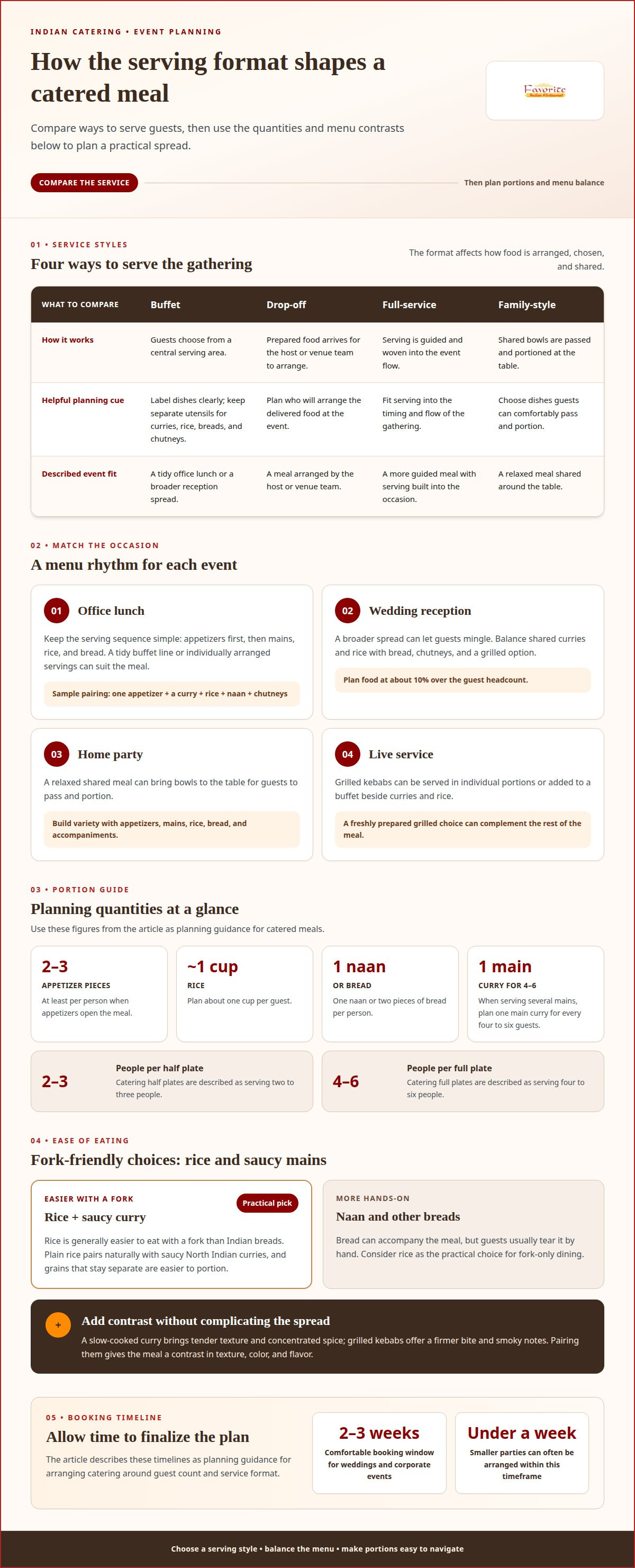
Buffet, drop-off, and full-service arrangements create different guest experiences. A buffet lets guests choose from a central serving area, so clear labels and separate utensils help distinguish curries, rice, breads, and chutneys. Drop-off catering brings prepared food to the event for the host or venue team to arrange. Full-service catering can support a more guided meal, with serving woven into the event flow.
For a corporate lunch, keep the serving sequence simple: appetizers first, followed by mains, rice, and bread. Samosas or pakoras make convenient opening bites, while a curry such as butter chicken offers a fork-friendly main. When appetizers are the opening course, plan at least two to three pieces per person. A practical sample menu pairs one appetizer with a curry, rice, naan, and chutneys, while accounting for dietary preferences.
Family-style serving brings shared bowls to the table, giving guests an easy rhythm for passing and portioning dishes. For catered meals, plan about one cup of rice per guest and one naan or two pieces of bread per person. When serving several mains, plan one main curry for every four to six guests. Catering half plates are described as serving two to three people, while full plates serve four to six.
Wedding planning calls for a buffer: plan food at about ten percent over the guest headcount. For weddings and corporate events, booking Indian catering two to three weeks ahead is described as comfortable; smaller parties can often be arranged in under a week. These timelines help shape menu decisions around guest count and service format. A catering menu can be tailored to the event’s style through Indian catering menu details.
For live service, grilled kebabs can be served in individual portions or added to a buffet alongside curries and rice. At a reception, this gives guests a freshly prepared choice without making the whole meal depend on a single station. Keep the menu balanced: a shared curry, a grilled option, rice, bread, and clearly presented chutneys make a varied spread easier to navigate.
Customizable menus for different events
An Indian caterer can adapt a menu for vegan, gluten-free, and nut-allergy needs by selecting recipes and reviewing ingredients. For allergy requests, the caterer should account for ingredients and preparation requirements; the host should share clear dietary details before finalizing the menu.
The event’s pace helps determine the menu structure. An Indian lunch party can follow a two-course format: a main dish, then dessert. An evening gathering can use a three-course sequence, moving from appetizers to mains and dessert. A casual office meal might keep courses together at a buffet, while a seated celebration can give each course its own moment.
Next, choose variety with purpose. A party menu can include two to three main dishes, balancing vegetarian and meat options instead of serving several similar curries. For example, a vegetarian curry with a warm masala profile can sit beside a chicken main, with rice and bread offering different ways to enjoy the sauces. Let guests’ dietary preferences and the occasion’s formality guide the combination.
Cooking method also shapes a customized menu. A slow-cooked curry brings tender texture and concentrated spice, while grilled kebabs offer a firmer bite and smoky notes. Pairing these preparations gives a buffet contrast in texture, color, and flavor. For a smaller lunch, one well-chosen main and dessert can feel complete; a longer dinner can include an appetizer course and more than one main.
Use a simple planning sequence to turn preferences into a menu:
- Set the format: Decide whether guests will eat at a buffet, around shared tables, or in served courses.
- Gather dietary details: Record vegan, gluten-free, and allergy needs clearly, including the specific ingredient concern.
- Choose the balance: Select vegetarian and meat dishes, then vary their cooking styles and spice profiles.
- Finish the meal: Match dessert to the event, such as a sweet ending after a richly spiced main.
For vegan menus, focus on vegetable- and legume-based dishes, then consider whether accompaniments suit the request. Gluten-free planning means reviewing each recipe and side rather than making assumptions based on a dish’s name. For nut allergies, ingredients and preparation needs both matter. Clear menu labels help guests identify suitable choices during service.
A sample celebration menu might begin with a vegetarian appetizer, continue with a vegetable curry and a chicken main, then finish with Indian sweets. Adjusting the dishes, cooking styles, and course order creates a menu that feels connected to the event, not assembled from unrelated choices.
Indian catering dishes and menu variety
A balanced Indian menu combines easy-to-serve staples with contrasting textures and flavors. Rice, breads, curries, and vegetarian dishes give guests choices for a shared meal.
Fork-Friendly Rice and Breads
Rice is generally easier to eat with a fork than Indian breads. Plain rice pairs naturally with saucy North Indian curries, while grains that stay separate are easier to portion. Naan can accompany the meal, but guests usually need to tear it by hand, making rice the practical choice for fork-only dining.
There isn’t one average price per person that applies to Indian catering throughout the United States. The total depends on menu selections, guest count, and serving format, so a single figure wouldn’t describe every event.
Easy-to-Eat Indian Dishes
Look for tender pieces and sauces that gather easily with rice. Butter chicken pairs chicken with a creamy curry, while chana masala offers chickpeas in spiced onion-tomato gravy. Boneless kebabs can also be portioned into fork-sized bites, adding a grilled option alongside saucier dishes.
Serving style affects how easily guests can manage each choice. In a buffet, shallow dishes make ingredients easier to see and reach; individual portions can suit a seated meal. Keep serving utensils with their matching dishes, and position rice near curries so guests can combine them conveniently on one plate.
For a varied spread, balance saucy mains with a firmer-textured choice. Kebabs add contrast to curry and rice, while bite-sized pieces are easier to eat without bread. Dahi Papri Chaat has crisp papdi, yogurt, potatoes, chickpeas, chutneys, and spices; its layered components may be less convenient for fork-only service than a cohesive curry.
Vegetarian and Mild Menu Choices
Vegetarian fork-friendly options include chana masala and other legume or vegetable curries served with rice. Soft ingredients are easy to gather in a forkful, and thick gravy helps hold the combination together. Offer a vegetarian main alongside a chicken dish for distinct choices that don’t rely on bread.
For guests who prefer less spice, choose a milder preparation and serve chutneys separately. Diners can then add a sharper or sweeter flavor to taste. Rice alongside a mild curry can also balance the plate, while a menu label helps guests identify the less spicy option at a glance.
A sample combination might include rice, a vegetarian curry, a chicken main, and chutneys on the side. Consider each dish’s texture, portioning, and place on the table so guests can build a comfortable plate with a fork.
Make-ahead curries, dals, chutneys, and appetizers
A thoughtful preparation schedule lets a gathering offer layered Indian cuisine without rushing every dish on party day. Curries, dals, chutneys, and appetizers each play a different role in preserving flavor and keeping service organized.
Curries and Dals for Advance Preparation
Curries, dal, chutneys, and marinades can be made one day before the party. Chana masala, with chickpeas in spiced onion-tomato gravy, is one hearty dish suited to advance preparation. For a varied spread, pair a legume-based option with another curry, then finish and portion each dish for the planned serving style.
Build the schedule around the event’s serving time. Keep refrigerated curries and dals chilled until it is time to reheat them; reheat thoroughly before serving and avoid leaving them at room temperature for extended periods. Sides can be prepared four to five hours before the party and refrigerated. This sequence gives the kitchen a clear order of work while keeping the final meal focused on fresh, balanced flavors.
For a birthday or family gathering, a curry and dal bring different textures to the table: one richly sauced, the other soft and spoonable. Paneer can also add a vegetarian element when it suits guests’ preferences. Keep dishes in separate serving vessels so each flavor stays distinct and guests can choose a combination they enjoy.
Chutneys and Appetizers for Advance Preparation
Dips and chutneys can be made two to three days ahead, giving their flavors time to come together before service. Store them refrigerated, then arrange them in separate bowls so guests can choose an accompaniment without blending every taste. A bright chutney beside a richly spiced curry adds contrast, while a milder option suits guests who prefer a gentler finish.
Appetizers can be prepared the day before the party, making the opening course easier to organize. Samosas and pakoras are familiar Indian starters; plan how to arrange and serve them alongside chutneys. For fork-friendly service, cut or portion appetizers into manageable pieces when appropriate, and keep sauces separate to reduce mess at a buffet or shared table.
Masala nuts can be made up to a week before the party, offering an additional snack as guests arrive. Keep them separate from the meal’s appetizers, and label ingredients clearly for guests with dietary needs. Make-ahead chutneys and starters, together with a prepared curry schedule, help the host serve a memorable spread without finishing every dish at once.
Together, these tasks give the host distinct windows: dips and chutneys 2 to 3 days ahead, refrigerated sides 4 to 5 hours before the party, and masala nuts up to a week in advance.
What Indian dishes are easiest to eat with a fork?
Fork-friendly Indian dishes usually have bite-sized pieces, a cohesive texture, or sauce that gathers easily with rice. Butter chicken, chana masala, paneer curry, and boneless kebabs are practical examples. The best fit depends on whether guests are seated, standing, or moving through a buffet line.
Texture matters as much as the recipe. Tender chicken or paneer pieces are easier to lift than large cuts, while chickpeas and lentils hold together in thick gravy. A fork can manage these foods without guests needing to tear bread. Keep rice nearby so diners can combine a little sauce and grain in each bite.
- Curries: Butter chicken and other thick, spoonable gravies pair neatly with rice.
- Legume dishes: Chana masala and dal are easier to gather when served with grains.
- Grilled items: Boneless kebabs in bite-sized pieces are simpler to pick up than skewered or large cuts.
- Appetizers: Pakoras can be forked when portioned into small pieces, while samosas are often easier to hold.
For buffet service, cut larger pieces before serving and use shallow dishes for saucy foods. This keeps chicken, vegetables, and paneer within easy reach of a fork. Fork-friendly Indian catering dishes are easier to navigate when vegetarian and meat options have separate serving utensils and clear placement.
Some Indian starters are less tidy for fork-only dining. Dahi Papri Chaat layers crisp papdi with yogurt, potatoes, chickpeas, chutneys, and spices; its crisp and soft components can shift as guests take a bite. Serve it in individual portions for a seated meal. At a standing reception, a less layered starter may be easier to handle.
Rice is a useful foundation, but cook it so it holds together for easy forkfuls without becoming sticky. Naan can accompany the meal, though guests may need to tear it by hand. A menu centered on rice, tender curry pieces, and a forkable vegetable or legume dish offers a straightforward dining experience.
When reviewing a menu, look at the size of each piece, the thickness of each sauce, and how dishes will be portioned. Those details matter more than whether a dish sounds familiar. Explore Indian catering options for an event menu built around comfortable, flavorful serving.
Malai Murgh Tikka is made with boneless chicken marinated in yogurt, cream, cheese, and spices before grilling or baking. Its boneless pieces suit a fork-friendly spread, particularly when portioned for easy serving, and pair well with a sauced main and rice.
For an Indian party with up to 8 guests, the suggested menu includes 1 to 2 appetizers, 2 main courses, and 1 dessert. For an Indian party with up to 16 guests, the suggested menu includes 2 appetizers, 3 mains, and 2 desserts. For an Indian party with more than 16 guests, the suggested menu includes 3 to 4 appetizers, 4 mains, and 2 to 3 desserts. For a casual Indian party with more than eight guests, disposable tableware is recommended. These menu proportions can help balance fork-friendly choices across the meal.
Best Indian Food in Hayward, CA | Favorite Indian Restaurant | Indian Food near me: Indian Food Catering
Best Indian Food in Hayward, CA | Favorite Indian Restaurant | Indian Food near me offers Indian Food Catering for gatherings where a coordinated spread suits the occasion. It’s a natural next step after choosing fork-friendly dishes and wanting a catered menu for an office event, wedding, or party.
Think about the meal’s format and variety: rice and curries make easy forkfuls, while a Live Indian Grill Experience adds freshly grilled choices. For dining at the restaurant, the Saturday Lunch Buffet and Weekend Dinner Buffet offer other ways to enjoy a range of Indian dishes. Match the option to your event and the experience you want guests to share.
Contact Best Indian Food in Hayward, CA | Favorite Indian Restaurant | Indian Food near me to discuss Indian Food Catering for your gathering.
Shape the Menu Around Your Gathering
Before settling on a menu, picture how guests will move through the event. A seated meal, a short office lunch, and a reception where people mingle call for different serving rhythms. Choose fork-friendly Indian dishes that suit that flow, then consider how the menu can welcome varied appetites without making each plate complicated.
For an event menu, the restaurant’s website is a useful place to check for information about available options. Consider the occasion, how guests will dine, and the variety you’d like to serve.
Let the occasion guide the details, from the balance of dishes to the way guests will enjoy them together. Visit Favorite Indian Restaurant’s website as you plan a flavorful gathering.
Frequently Asked Questions
Which Indian appetizers are fork-friendly for catering?
Pakoras and boneless kebab pieces are convenient fork-friendly starters, especially for seated meals. For a reception where guests are standing, choose compact portions that stay together on a small plate. Samosas are tasty, but their pastry makes them easier to pick up by hand. Dahi Papri Chaat has layered textures, so individual servings can be easier to manage than a shared platter.
What Indian main dishes work well for fork-only meals?
Choose mains with tender, boneless pieces or soft ingredients that a fork can lift cleanly. Chicken Tikka Masala, Butter Chicken, Shahi Paneer, and Chana Masala are useful examples, served with rice for guests who prefer not to use bread. For a mixed menu, pair a meat curry with a vegetarian main, and keep sauces thick enough to cling to rice rather than run across the plate.
How does a professional caterer serve and portion fork-friendly Indian dishes?
A caterer can adapt portion size and presentation to the event format, placing bite-sized items in individual servings or arranging mains in buffet dishes for guests to serve themselves. Separate utensils help keep each dish distinct, while labels can identify vegetarian choices and common ingredients. For a seated meal, plate rice beside the main; for a buffet, place rice and serving tools within easy reach of the curries.