For diners considering an all-you-can-eat halal buffet in Oakland, reviews and menu details answer different questions. Reviews describe individual dining experiences, while menu information is the place to look for halal meat and vegan dishes. Don’t assume either from the buffet label alone.
This guide explains how to assess customer feedback, distinguish halal meat from vegan choices, and plan for a group with different dietary needs. It also covers the buffet and grill experience in Hayward, so you can see how Best Indian Food in Hayward, CA | Favorite Indian Restaurant | Indian Food near me fits a search for Indian dining near Oakland.
Key Takeaways
- Use customer reviews to understand diners’ impressions, but rely on menu details for specific dietary information.
- Halal meat and vegan dishes are different menu considerations; identify which options meet your needs before choosing a buffet.
- Understand what a restaurant’s halal claims do and don’t tell you about its food and preparation.
- Appearance alone can’t establish whether a dish is halal, so distinguish visual impressions from clear menu information.
- For Indian buffet and grill dining near Oakland, Favorite Indian Restaurant in Hayward offers a Halal Indian Grill, buffet experiences, and a Live Indian Grill Experience.
Customer reviews
Customer reviews can help Oakland diners assess a buffet experience, but treat them as accounts of individual visits, not guarantees. A comment about a busy evening describes one visit; it cannot establish how every service runs. Separate specific observations from broad praise when weighing a review.
Start with the date of each comment. Recent feedback may better reflect current service than older posts. Note the meal period, if the writer names it: a Saturday lunch visit may differ from dinner. Don’t treat those experiences as interchangeable when comparing comments.
Look for details you can interpret. A reviewer might describe how quickly dishes were replenished or whether a group found the seating comfortable. These are concrete observations. A rating without context offers less insight into timing, selection, or the overall meal.
Group similar comments by topic rather than counting stars alone. For example, collect remarks about food temperature together and keep comments about staff interactions separate. This helps show which parts of the experience reviewers actually discuss, without implying every diner had the same result.
Read negative feedback with equal care. A specific concern about a delayed dish gives more context than a general complaint. Check whether the writer explains the circumstances. One account may reflect an unusual visit, while repeated, detailed comments can point to a pattern worth considering.
Reviews also have limits. A diner’s impression of flavor cannot confirm ingredients or dietary suitability, and a positive comment doesn’t prove every buffet dish meets a particular need. Use reviews to understand reported experiences, then consult menu information for food-specific decisions.
For a useful comparison, apply the same questions to each set of comments:
- Does the review identify lunch or dinner?
- Does it describe particular dishes or service details?
- Is the comment recent enough to inform your plans?
- Does it explain the rating with a clear example?
- Do similar comments appear across multiple visits?
These questions keep the process practical. If a comment praises variety, look for details about what the writer means. If another mentions a wait, note whether it describes a specific time or circumstance. Don’t turn either statement into a promise about your own visit.
Compare feedback with the meal format being discussed. The restaurant’s buffet details provide context for distinguishing comments about different service periods. That makes review comparisons more precise, especially when a post omits the time or type of visit.
Treat reviews as one part of your decision. Use them to understand the experiences people describe, not to infer facts they don’t provide. A well-grounded choice combines dated, detailed feedback with relevant menu information and your dining group’s needs.
Halal meat and vegan menu options
Halal and vegan describe different things. Halal concerns whether meat meets halal requirements; vegan food excludes animal-derived ingredients. A buffet can include halal meat without offering vegan dishes, or serve vegan dishes without serving halal meat. Treat these as separate menu questions.
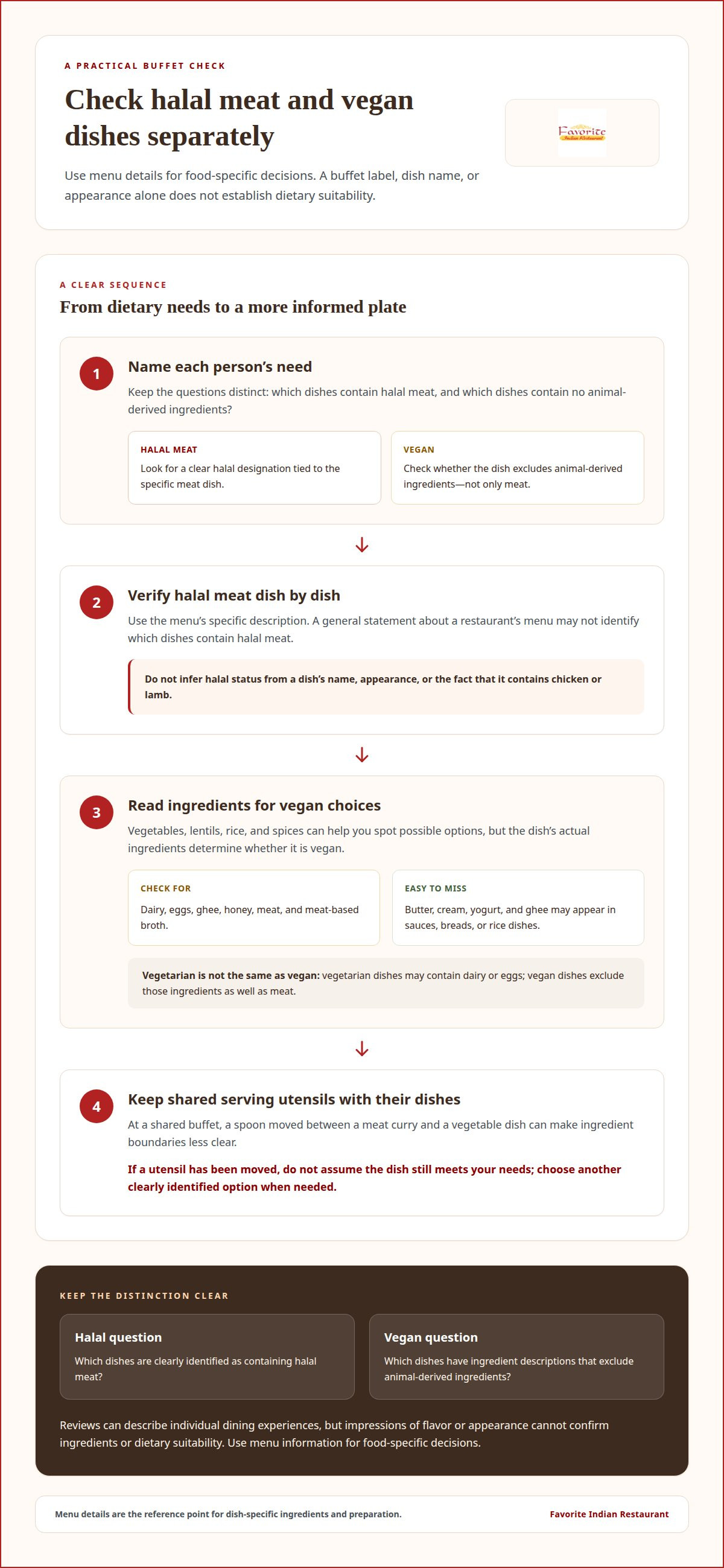
Begin with the ingredient list for each dish. For meat, look for a clear halal designation tied to that item. A general statement about a restaurant’s menu may not identify which dishes contain halal meat. For vegan choices, check for dairy, eggs, ghee, honey, meat, and meat-based broth. Dish names alone may not reveal every ingredient.
Indian cuisine includes dishes built around vegetables, lentils, rice, and spices. These categories can help you spot possible vegan choices, but they don’t establish that a particular buffet dish is vegan. A vegetable curry may contain dairy, for example, while a lentil dish may use broth. Check the ingredient information for the actual dish.
Watch for easy-to-miss ingredients. Butter, cream, yogurt, and ghee are dairy products that can appear in sauces, breads, or rice dishes. Some preparations may use eggs, too. For a vegan meal, a vegetable-based name isn’t enough. Look for an ingredient description that addresses animal products.
Halal meat needs its own clear identification. Don’t infer that chicken or lamb is halal because it appears in an Indian dish. Likewise, a vegetarian label doesn’t establish that meat served elsewhere is halal. Keep the questions distinct: which dishes contain halal meat, and which contain no animal-derived ingredients?
For a group with different needs, sort choices before filling plates. Use a simple three-part check:
- Identify dishes explicitly described as halal meat.
- Find vegan options by reading their ingredient descriptions.
- Keep separate serving utensils with the dishes they belong to.
That final step matters at a shared buffet. A spoon moved between a meat curry and a vegetable dish can make ingredient boundaries less clear. Don’t assume a dish remains suitable if its serving utensil has been moved. Choose another clearly identified option when needed.
Also distinguish vegan from vegetarian. A vegetarian dish may contain dairy or eggs. Paneer, yogurt, cream, and ghee are common animal-derived ingredients. Vegan dishes exclude those ingredients as well as meat. Read descriptions carefully rather than treating the labels as interchangeable.
For diners seeking an all-you-can-eat halal buffet in Oakland, menu clarity is more useful than appearance. A rich sauce may look dairy-free but contain cream; a vegetable dish may seem suitable but use animal-based broth. Make decisions from ingredient descriptions, not color, texture, or a dish’s name.
When a menu distinguishes halal meat details from vegan ingredients, mixed-diet groups can choose with greater confidence. Note each person’s needs first, then match them to clearly described dishes. This keeps halal meat selection and vegan dining needs distinct, even when both matter at one meal.
For Favorite Indian Restaurant, check the official menu for dish-specific preparation and ingredient details. A tandoor-prepared item, if listed, describes a cooking method; it does not by itself establish that the meat is halal or provide a full ingredient list. Look for an explicit halal identification and verify ingredients for the specific dish. Don’t infer halal status from the cooking method.
Authentic halal
A halal claim needs a clear scope. “Halal meat” describes meat, not automatically every buffet dish. A menu may include meat, vegetables, bread, sauces, and sweets, each with its own ingredients and description. Read the wording precisely, and don’t extend a claim beyond the food it names.
Separate three kinds of information: a restaurant’s general statement, a dish label, and an ingredient description. A general statement about meat doesn’t identify which curry contains it. A dish label can identify a specific choice, while an ingredient description adds detail about its preparation. Each answers a different question.
Buffet wording matters, too. A label beside one tray applies most directly to that dish. A menu statement about meat may cover a broader selection, but it still doesn’t describe every side. Keep the claim within its stated scope, rather than treating a meat claim as a statement about the whole spread.
Certification language is another distinct detail. A restaurant’s statement and a named certification are not the same kind of information, so don’t assume one from the other. If a menu mentions certification, note exactly what it identifies. If it describes halal meat without naming a certificate, preserve that distinction.
Specific wording makes a claim easier to interpret. Compare “halal options available” with a menu that labels particular meat dishes. The latter gives diners a clearer starting point, but it still doesn’t answer every question about ingredients or preparation. Read each description within its stated limits.
Visual cues cannot establish halal status. A charred chicken piece, aromatic curry, or neatly arranged tray may look appealing, but appearance tells you about presentation, not the basis of a halal claim. A dish’s name or cuisine cannot prove how its meat was sourced or prepared, either.
For a mixed group, record each diner’s requirement separately. One person may need halal meat, another may avoid meat entirely, and someone else may need ingredient details. These needs aren’t interchangeable. A clearly labeled chicken dish addresses a different question from a vegetable dish’s ingredient list.
Use a simple reading sequence. First, identify the exact claim. Next, note whether it refers to all meat, selected dishes, or a named item. Then keep ingredient questions separate. For example, “halal chicken” identifies a meat claim, while “contains dairy” describes an ingredient. Neither statement answers the other question.
Careful wording supports an informed choice. Treat “halal,” “vegetarian,” and “vegan” as distinct labels with distinct meanings. A vegetarian label alone doesn’t establish that meat is halal, and a halal meat label alone doesn’t establish that a dish contains no animal-derived ingredients. Match each detail to the diner’s actual need.
Royal Kitchen offers 100% halal meats. Read that statement as a claim about the meats the wording covers, rather than as automatic confirmation about every dish or ingredient. The percentage gives the claim a clear breadth within that category, but it does not identify individual menu items, recipes, or preparation details. Keep those questions open unless the restaurant’s wording answers them. If you are choosing a particular meal, match the claim to the item you intend to order and avoid carrying it across to unrelated parts of a meal.
A useful follow-up is to ask which listed dishes contain halal meat and whether the description applies to the selection you’re considering. If ingredient information matters, ask about it separately: a meat claim doesn’t provide an ingredient list. Keep any answer within its stated scope when sharing it, so no one mistakes a claim about meat for a wider assurance. This respects the claim without extending it: acknowledge what Royal Kitchen states, then seek item-specific information when it matters to your choice.
Looking halal
A dish’s appearance can be appealing, but it doesn’t establish halal status. Color, garnish, and cooking marks show presentation, not sourcing. A label’s wording is more useful than a symbol or photograph. Read the words attached to the specific item, and keep visual impressions separate from stated details.
Buffet displays often use several kinds of signs. A dish name identifies what is served, a cuisine label describes its style, and a dietary symbol may signal an intended category. These signs don’t all communicate the same thing. Focus on the written description, not decorative lettering.
Pay attention to placement. A card between two trays may not make its intended dish clear. Match the card’s name to the container beside it. If the display includes serving labels and a separate menu board, compare dish names carefully. Similar names don’t necessarily mean the same preparation.
Menu photographs offer a different kind of information. They can help identify a familiar dish or show its serving style, but they can’t reveal sourcing, ingredients, or how a claim applies. Use an image to recognize a dish, then rely on accompanying words for details the image cannot show.
Keep these visual-reading habits in mind:
- Read the complete label, not only its largest words.
- Match each card to the dish it names.
- Separate a dish name from a dietary claim.
- Treat symbols and colors as design, not proof.
- Use photographs to identify dishes, not their status.
Typography can affect how a sign reads. Large headings may draw attention while a smaller note carries the relevant detail. Scan the full card before deciding what it says. A prominent “grill” or “vegetable” label describes a category or style, not necessarily every dietary characteristic.
Notice whether the wording refers to one dish or the whole menu. A small sign beside a single tray has a narrower context than a general banner. Keep the description connected to the item it accompanies. Don’t extend one card’s message to neighboring dishes just because they share a display.
Consistent reading can prevent confusion in a group. Each diner can identify the dish, read its attached description, and distinguish written claims from visual styling. This keeps decisions grounded in the information presented, rather than assumptions based on color, garnish, or familiar appearance.
For an Indian dining experience, explore halal Indian dining options and use the available descriptions to guide your choices. Clear attention to wording helps make a buffet selection more deliberate and comfortable for the whole table.
Best Indian Food in Hayward, CA | Favorite Indian Restaurant | Indian Food near me: Halal Indian Grill
Favorite Indian Restaurant offers diners near Oakland a Halal Indian Grill in Hayward, alongside buffet dining. The Saturday Lunch Buffet and Friday and Saturday Dinner Buffet suit diners looking for a shared meal, while the Live Indian Grill Experience brings freshly grilled flavor to the occasion.
Choose the buffet for a broader meal, or the grill experience when grilled dishes are the focus. For Oakland diners comparing halal buffet options, Favorite Indian Restaurant offers a nearby alternative in Hayward, not Oakland. The best format for your group depends on whether you prefer a buffet spread or a grill-centered meal. Contact Favorite Indian Restaurant to discuss your dining plans.
Plan a meal that fits your group
Before choosing an all-you-can-eat halal buffet in Oakland, agree on what will make the outing work for everyone. Your group may value a relaxed shared meal, while another group may prefer dining centered on grilled dishes. Set that priority first to make the choice more straightforward.
Then make the next step practical. Keep the restaurant’s menu and dining format in view as you plan, especially when guests have different preferences. A little coordination helps everyone focus on enjoying the meal rather than sorting out choices after arriving.
For a welcoming Indian dining experience, explore the options at Favorite Indian Restaurant and choose what best suits your plans. Explore dining options, and take the next step toward a meal shared with ease.
Frequently Asked Questions
Which restaurants in Oakland, California offer all-you-can-eat halal buffets?
Favorite Indian Restaurant in Hayward is an East Bay option for diners near Oakland. It offers buffet dining and a Halal Indian Grill, but isn’t an Oakland venue. If dining within Oakland city limits is essential, use each restaurant’s listed address to distinguish Oakland locations from nearby East Bay choices. Confirm that the format is all-you-can-eat, not à la carte.
Are the halal buffets in Oakland fully halal-certified, and what meat do they serve?
A halal-food description and formal certification are separate claims. Favorite Indian Restaurant identifies as a provider of halal Indian food and offers a Halal Indian Grill. This supports describing its halal offering, but not calling it certified. Its listed meat dishes include chicken, goat, and lamb preparations. For any Oakland buffet, treat certification wording as a separate claim rather than assuming it follows from a halal label or menu description.
What cuisines and dishes are included in Oakland halal buffet menus?
Buffet selections vary by restaurant. Favorite Indian Restaurant specializes in Punjabi and North Indian cuisine, with dishes such as chicken tikka masala, lamb korma, shahi paneer, and chana masala among its menu offerings. Naan and gulab jamun are also listed. These examples show the cuisine, but don’t promise that every dish appears at each buffet service.
Are vegetarian, vegan, or allergy-friendly options available at Oakland halal buffets?
Favorite Indian Restaurant offers vegetarian dishes, including paneer-based and lentil dishes. Vegetarian food isn’t necessarily vegan: paneer, cream, and ghee come from animals. Allergy needs also call for ingredient-specific information. Vegetarian or vegan labels alone don’t answer questions about allergens or cross-contact, so consider those needs separately when choosing dishes.
Which Oakland halal buffet restaurants have the best ratings and recent reviews?
You can’t name a restaurant as having the best current rating without comparing up-to-date scores and reviews. Look for recent written comments, review dates, and whether diners specifically describe buffet visits. A high rating may reflect other meals, not buffet service. Give more weight to recurring, detailed observations about the buffet than to one unusually positive or negative account.
Are there all-you-can-eat halal buffets near Oakland in nearby East Bay cities?
Hayward is a nearby East Bay option for diners near Oakland, with buffet dining and a Halal Indian Grill at Favorite Indian Restaurant. Other nearby cities include San Leandro, San Lorenzo, Castro Valley, Fremont, Union City, Newark, Dublin, Pleasanton, and Oakland. Compare each address and buffet format separately, so a nearby East Bay restaurant isn’t mistaken for an Oakland location or an all-you-can-eat service.