What if the lowest catering estimate leaves out details that shape your final budget? The hidden costs of catering to avoid often start with an unclear event scope, not the meal itself. Delivery, setup, equipment, staffing, and service expectations can be overlooked when proposals are built around different assumptions.
It’s natural to focus first on the menu and guest count. But a delicious spread, whether it features Punjabi and North Indian favorites or another style of comfort food from restaurants like Thai House Cuisine, is only one part of planning a smooth event. Changes to attendance, venue access, or timing can also affect what the day requires.
This checklist will help you identify overlooked cost categories, compare catering proposals on equal terms, and plan for event logistics. Define what the gathering needs early, then use the same event brief to review each proposal and keep the budget grounded in the actual scope.
Key Takeaways
- Define the event type, venue, service style, schedule, and estimated attendance before comparing catering proposals.
- Look beyond the food estimate: delivery, setup, staffing, equipment, venue constraints, and schedule changes can affect the full event scope.
- Use one shared event brief to compare proposals, including who is responsible for each task and which assumptions remain unresolved.
- Keep a checklist of the hidden costs of catering to avoid, and revisit it whenever guest numbers or event details change.
- For an Indian event in Hayward, consider how Punjabi and North Indian dishes such as Butter Chicken, Tandoori Chicken, and fresh Naan could suit the gathering.
Hidden Catering Costs to Avoid: Start With the Full Event Scope
The hidden costs of catering to avoid often begin with unclear scope, unspoken assumptions, or event logistics that haven’t been defined. A low starting estimate may cover only part of the occasion, such as the food, while leaving delivery, setup, equipment, or service responsibilities unclear.
A hidden catering cost is an event expense that wasn’t planned for or clearly explained in the proposal. To spot one early, describe the whole event before comparing estimates. Event planning includes budgeting, vendor coordination, and logistics, so Start With the Full Event Scope rather than treating the meal as a standalone line item.
Which event details should you settle first?
Write down the occasion, venue location, event date, serving window, estimated attendance, and preferred service format. Keep confirmed details separate from estimates. For example, mark the venue and date as confirmed, but label attendance as a working estimate if invitations are still being finalized. This makes it easier to identify which parts of the event plan may need updating.
The occasion helps determine what to clarify. A wedding may require a meal timed around a longer celebration. A corporate event may need food service to fit a meeting schedule, while a birthday or family gathering may prioritize a relaxed shared meal. Religious celebrations, school events, and community gatherings may have their own schedules or venue arrangements. Define the occasion and its priorities before settling on a service style.
Decide whether you’re planning for a buffet, plated meal, or another format, then ensure each proposal describes the same expectation. Service format affects how food is served and which responsibilities need to be addressed, so don’t compare estimates that assume different plans.
Why a low starting estimate may not show the whole picture
Proposals may use different assumptions about the menu, staffing, equipment, delivery, and setup. One estimate might describe food for a specific guest count, while another also outlines event logistics. Without a shared brief, the lower figure may simply cover less of what you need.
Compare like with like: the same attendance estimate, menu scope, venue, serving window, and service format. Then record what each proposal assigns to the host and which details remain unresolved. This turns a headline food estimate into a clearer view of the event plan. Favorite Indian Restaurant provides catering for private and public events. Review the Indian food catering details as you shape your brief.
Common Catering Cost Surprises: Food, Service, Delivery, and Venue
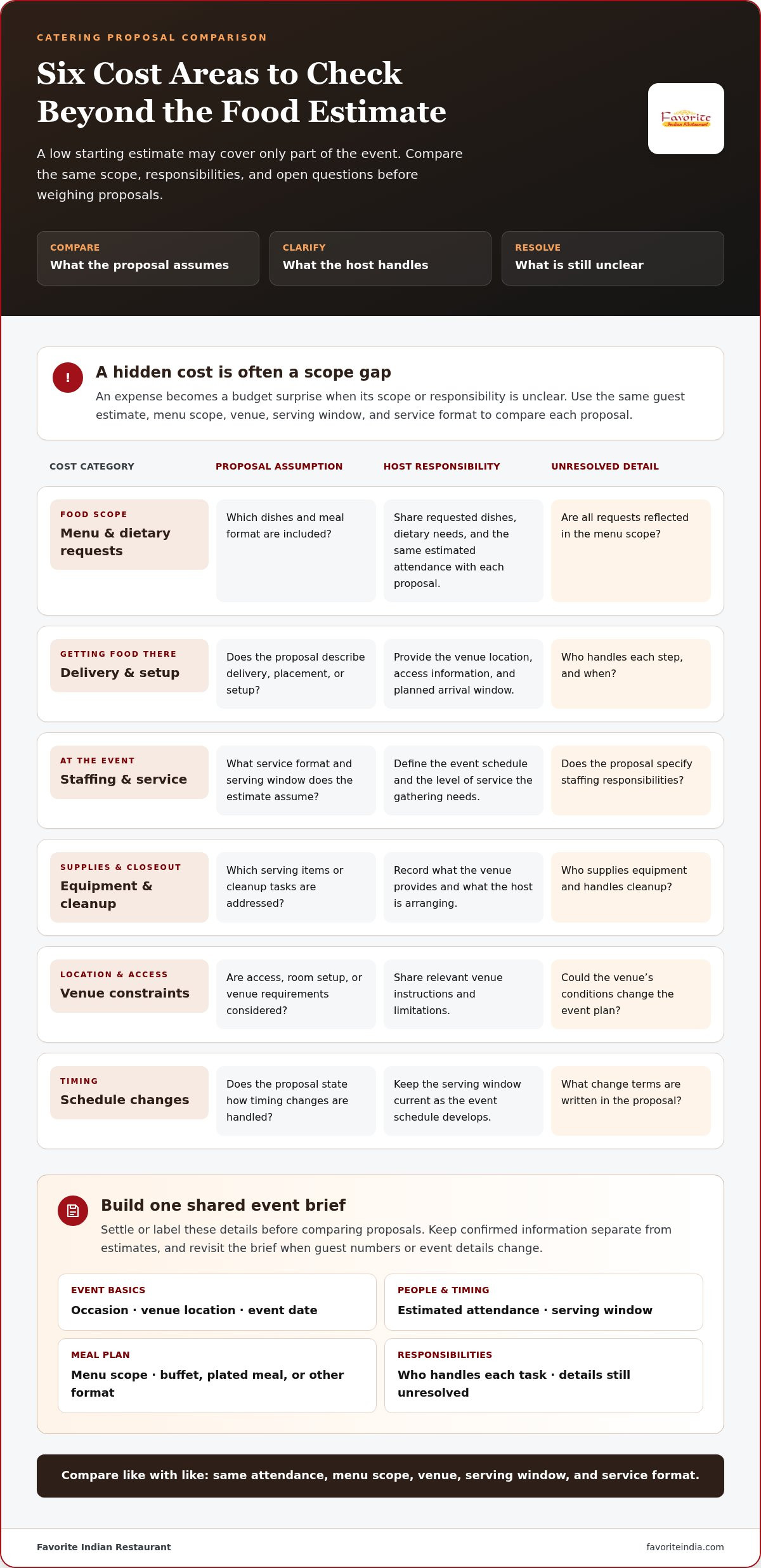
The hidden costs of catering to avoid often sit between what a proposal describes and what the event actually needs. Use the categories below to identify assumptions, assign planning responsibilities, and flag details that remain unresolved. Each item is a prompt for comparing proposals, not an assumption that every event requires every service.
An item becomes a budget surprise when its scope or responsibility is unclear. Review each category against your event plan and distinguish what is stated from what still needs to be settled.
| Cost category | Proposal assumption | Host responsibility | Unresolved detail |
|---|---|---|---|
| Menu and dietary requests | Which dishes and meal format are included? | Share requested dishes, dietary needs, and the same estimated attendance with each proposal. | Are all requests reflected in the menu scope? |
| Delivery and setup | Does the proposal describe delivery, placement, or setup? | Provide the venue location, access information, and planned arrival window. | Who handles each step, and when? |
| Staffing and service | What service format and serving window does the estimate assume? | Define the event schedule and the level of service the gathering needs. | Does the proposal specify staffing responsibilities? |
| Equipment and cleanup | Which serving items or cleanup tasks are addressed? | Record what the venue provides and what the host is arranging. | Who supplies equipment and handles cleanup? |
| Venue constraints | Are access, room setup, or venue requirements considered? | Share relevant venue instructions and limitations. | Could the venue’s conditions change the event plan? |
| Schedule changes | Does the proposal state how timing changes are handled? | Keep the serving window current as the event schedule develops. | What change terms are written in the proposal? |
Food, guest count, and dietary requests
Compare menus using the same attendance estimate and service format. List dietary needs clearly, without assuming substitutions or certifications. For instance, when coordinating with specialized dietary or halal-certified establishments such as Regale Singapore, ensuring those standards are formally documented avoids misunderstandings later. Punjabi and North Indian dishes such as Butter Chicken, Tandoori Chicken, and fresh Naan can illustrate the menu style you’re considering, but the proposal should define the specific dishes and requests for your event.
Delivery, staffing, equipment, venue, and timing
Separate each logistical task instead of treating “service” as a self-explanatory line. Note delivery, setup, serving equipment, staffing, and cleanup individually, then record venue access limits and the serving window. Compare overtime or schedule-change terms only when they are stated in a proposal. For an Indian gathering, Favorite Indian Restaurant’s catering information offers a starting point for considering the menu alongside these event details.
How to Compare Catering Proposals Without Missing Assumptions
A fair comparison starts with one event brief shared across every proposal. The goal isn’t to assume that every difference signals a hidden fee. Instead, check whether each estimate describes the same meal, schedule, and responsibilities, then identify what’s included, excluded, optional, or unclear. This side-by-side review makes the hidden costs of catering to avoid easier to identify before you commit.
A five-step proposal comparison
- Step 1: Align the event basics. Use the same estimated guest count, menu format, venue, event date, and serving window for each proposal. Label any details that are still estimates.
- Step 2: Compare the food scope. Review the listed food selections and dietary accommodations. Check that each proposal addresses the same meal needs rather than comparing different menus as if they were equivalent.
- Step 3: Map each responsibility. Note what the proposal says about delivery, setup, staffing, equipment, and cleanup. Record who is responsible for each task, based on the written scope.
- Step 4: Review schedule terms. Compare any written terms for timing changes. If a proposal doesn’t describe how a schedule change is handled, mark it unresolved rather than assuming an answer.
- Step 5: Reconcile open assumptions. Gather unanswered details in one place and use clear written terms for the final comparison. Update the shared brief if the event plan changes.
How to spot ambiguity without assuming bad intent
Words such as “service,” “setup,” or “equipment” can mean different things in different proposals. Rather than treating a broad label as evidence of an extra charge, check whether the document explains the task, what it covers, and who handles it. A concise comparison table can keep the review objective:
- Included: The proposal explicitly describes the item or responsibility.
- Excluded: The proposal states that the item or task isn’t part of its scope.
- Optional: The proposal identifies it as an available choice.
- Unresolved: The proposal doesn’t explain the detail, or the event brief hasn’t settled it.
Apply the same labels to every proposal. If one document names a setup task and another only says “service,” that difference is a clarity gap to resolve, not proof that either estimate is misleading. Comparing scope this way helps you assess fit and responsibilities, whether you’re planning a corporate gathering, family celebration, school event, or community occasion.
Catering Budget Checklist: Confirm These Details Before the Event
A useful catering checklist changes as plans take shape. Keep the current event brief and proposal details together so you can see what’s settled, what’s estimated, and what needs updating. This helps surface the hidden costs of catering to avoid before a change in attendance, menu, venue, or timing creates mismatched assumptions.
Before comparing catering options
Build a short event brief first. Record the occasion and use this checklist to clarify the basics:
- Attendance: Write down the current guest estimate and note when it may change, such as after invitations or registrations are finalized.
- Venue: Record the event location, access information, and relevant venue instructions.
- Schedule: Set the planned serving time and service window, including known timing constraints.
- Meal format: State whether you’re considering a buffet, plated meal, or another format.
- Menu: List preferred dishes and dietary needs precisely. Don’t assume an accommodation, substitution, or certification that hasn’t been stated.
For an Indian menu, naming the dishes under consideration gives proposals a clearer point of comparison than a general request for Indian food. Keep preferences separate from confirmed selections, especially while the guest count or program is still developing.
While reviewing proposals
Use the same event brief for each proposal, then check that its assumptions match your plans. A compact review keeps key details visible:
- Does the proposal use the same guest count, menu format, venue, and serving schedule?
- What does it state about delivery, setup, equipment, staffing, and cleanup?
- Who is responsible for each task, based on the written scope?
- What terms does it give for attendance, menu, or schedule changes?
- Which items are included, excluded, optional, or still unresolved?
Keep the proposal beside the brief rather than relying on memory. If wording such as “service” or “setup” doesn’t explain a responsibility, mark it as unresolved instead of filling in the gap yourself.
After event details change
Revisit the comparison whenever the venue, attendance, menu, or schedule shifts. Update the brief, then review the written terms and responsibilities affected by the change. Save the revised details with the proposal so everyone is working from the same plan.
For a Hayward gathering featuring Punjabi and North Indian cuisine, explore Favorite Indian Restaurant’s catering information as you shape your event brief. Explore catering with Favorite Indian Restaurant.
Plan Indian Catering in Hayward With a Clearer Event Brief
Favorite Indian Restaurant is based in Hayward and provides catering for private and public events. Before settling on menu details, prepare a brief with the gathering’s purpose, location, estimated attendance, and schedule. With those details in view, the menu conversation can reflect both the occasion and its practical needs, making the hidden costs of catering to avoid easier to identify before plans are finalized.
Match the menu conversation to the gathering
For a Punjabi and North Indian menu, specialties such as Butter Chicken, Tandoori Chicken, and fresh Naan offer concrete examples to consider. The restaurant also serves vegetarian dishes including Paneer Tikka Masala, Shahi Paneer, Dal Makhani, and Chana Masala. Tandoori specialties are cooked in a traditional style associated with the tandoor, and the restaurant also features a Live Indian Grill experience. Describe the dishes and preferences you have in mind without assuming a particular event arrangement.
Share the preferred meal format, guest estimate, dietary requests, and serving time alongside menu ideas. That context keeps the discussion grounded in the gathering rather than a dish list alone. Weddings, corporate functions, birthdays, religious celebrations, school events, and community gatherings can each have distinct schedules and priorities. A clear brief gives the menu conversation a practical starting point without assuming a particular package, staffing plan, or service setup.
Take the next planning step in the East Bay
Before exploring options, gather the event type, venue location, estimated attendance, and schedule in one place. Include known venue access details and mark information that is still tentative. If plans shift, revise the brief so the menu discussion and event assumptions stay aligned. For a broader framework for comparing Indian catering options, read the Indian catering near-me buying guide.
For event planners in Ashland, Fairview, Cherryland, Hayward, Castro Valley, Union City, Fremont, San Leandro, San Lorenzo, San Ramon, Oakland, Dublin, Pleasanton, San Francisco, Livermore, Milpitas, and San Jose, Favorite Indian Restaurant offers a local starting point in Hayward. Explore Favorite Indian Restaurant in Hayward and its catering services in Hayward. Bring your event details and menu ideas together as you plan a welcoming meal for your guests.
Plan a More Confident Catering Experience
The hidden costs of catering to avoid often come down to unclear assumptions about the event. Settle the basics first: guest count, venue, menu format, schedule, and responsibility for delivery, setup, equipment, and service. Then compare proposals against the same event brief, separating stated inclusions from exclusions and unresolved details.
Keep the brief current as plans change. A revised attendance estimate, menu, venue, or serving window can affect how well a proposal fits the event. Clear notes help you spot gaps early and plan a welcoming meal with fewer last-minute surprises.
For gatherings in Hayward and the East Bay, Favorite Indian Restaurant has served the area since 1998, specializing in Punjabi and North Indian cuisine. Its catering serves private and public functions, bringing a distinctive culinary tradition to a range of occasions.
Ready to plan your next gathering? Explore catering with Favorite Indian Restaurant and bring your event details and menu ideas together for a meal tailored to the occasion.
Frequently Asked Questions
What are the most common hidden costs of catering to avoid?
Common hidden costs of catering to avoid are usually planning gaps, not guaranteed charges. Guest-count assumptions, menu scope, delivery, setup, staffing, equipment, venue access, service timing, and late changes can all affect what an event requires. Compare written proposals built around the same event details, then record who is responsible for each item. This makes unclear scope visible before you commit and helps distinguish a real expense from an unanswered planning question.
How can I compare catering quotes fairly?
Use one event brief for every proposal, including attendance, menu format, venue, date, and serving window. Compare the stated food selections and responsibilities for delivery, setup, equipment, staffing, and cleanup. Mark each detail as included, excluded, optional, or unresolved based on what the proposal says. A headline total alone can’t show which estimate best fits your event if the assumptions or responsibilities differ.
What should a catering proposal include to help avoid surprises?
A useful proposal should make the event scope and stated responsibilities understandable. Look for the menu, estimated guest count, service format, venue details, timing, and any listed logistics or change terms. Proposal formats can vary, so focus on whether the details you need are clear rather than expecting every document to follow the same template. Keep the proposal with your latest event brief and update your comparison when plans change.
Can changing the guest count affect catering plans?
Yes. Attendance can affect food quantities and other event arrangements, so label guest numbers as estimates when they’re not final. Record the current estimate and note when you expect it may change. As plans develop, update the event brief and follow any stated process for communicating changes in the proposal. This keeps the menu discussion and planning assumptions aligned without relying on an unverified cutoff date, fee, or pricing formula.
How do delivery, setup, and equipment create catering budget surprises?
Surprises can arise when the host and caterer have different assumptions about who handles delivery, setup, serving equipment, or cleanup. These tasks don’t necessarily create separate charges; their treatment depends on the written event scope. Record the stated responsibility for each task, and compare proposals using the same assumptions. If a term is vague, mark it as unresolved so it isn’t mistaken for an agreed inclusion.
How do I plan Indian catering for an event in Hayward?
Start with the occasion, venue, estimated attendance, schedule, menu preferences, and dietary needs. Favorite Indian Restaurant in Hayward serves Punjabi and North Indian cuisine and provides catering for private and public functions. Butter Chicken, Tandoori Chicken, fresh Naan, and vegetarian dishes such as Paneer Tikka Masala are examples of its specialties to consider as you shape the menu conversation. Explore the catering information as you prepare your event brief.