A generous-looking lunch can still leave an employee unsure what’s safe to eat. Successful catering for employees with dietary restrictions starts before the food arrives: gather needs respectfully, then make choices using clear menu and ingredient information rather than assumptions.
Workplace meals can involve allergies, intolerances, religious practices, and personal preferences. The goal isn’t to make one menu suit everyone. It’s to give employees a private, comfortable way to share relevant needs and choose dishes with confidence.
This guide offers a practical approach for Hayward and East Bay workplaces. You’ll learn how to collect and organize dietary requests, compare catering menus and meal formats, and communicate food details clearly. Favorite Indian Restaurant’s Punjabi and North Indian catering includes vegetarian dishes such as Dal Makhani, Chana Masala, Shahi Paneer, and Paneer Tikka Masala. They offer flavorful options to consider alongside your team’s specific requirements. With thoughtful planning, a shared meal can feel welcoming, satisfying, and easier to coordinate around a busy workday.
- Plan catering for employees with dietary restrictions by collecting needs respectfully instead of making assumptions about the team.
- Compare menus by ingredient detail and clear dietary categories, not simply by the number of dishes offered.
- Choose between individual meals, shared platters, and buffet-style service based on employee choice, food information, and workplace logistics.
- Use a straightforward sequence to gather requests, select a format, review menu details, communicate choices, and prepare service.
- For a Hayward workplace meal, consider Punjabi and North Indian catering from Favorite Indian Restaurant.
Catering for Employees with Dietary Restrictions: Start with What the Team Needs
Inclusive catering starts by asking employees what they need, not guessing based on their job roles, backgrounds, or the food the team usually orders. For catering for employees with dietary restrictions, a short, private request process gives planners useful information and helps prevent last-minute assumptions.
Inclusive workplace catering means offering clear choices supported by accurate food information, so employees can decide what works for them. Ask only for details that help plan the meal. Limit who can see the responses, and share relevant information with the people coordinating food service.
How should an organizer gather employee dietary needs?
Send a concise form or message with a clear response deadline. Offer a private reply option, such as a direct message to the organizer, rather than asking people to explain their needs in a public chat or meeting. Let employees describe their requirements in their own words.
Keep requirements separate from preferences. “Must avoid dairy” is different from “prefers mild food,” and a cuisine preference doesn’t show whether a dish meets an allergy-related need. A simple planning record can include:
- The dietary requirement or ingredient to avoid
- Whether the request concerns an allergy, religious practice, ethical choice, or preference
- A private way to follow up if the organizer needs clarification
Limit the record to relevant planners and use it to guide menu review, not to label or single out employees. For an event in Hayward, Favorite Indian Restaurant provides Indian food catering for workplace functions, giving organizers a local option to consider.
Which dietary needs should the planning checklist distinguish?
Use specific categories rather than treating “vegetarian” or “special diet” as a complete description. Vegetarian, vegan, dairy-free, and gluten-free requests are not interchangeable. One label doesn’t establish that a dish suits another requirement. Ask employees to identify the relevant restriction without requesting a diagnosis.
- Dietary pattern: vegetarian or vegan.
- Ingredient exclusion: dairy-free, gluten-free, or a named ingredient to avoid.
- Religious preference: record a Halal request as stated. Don’t assume that a general menu label explains certification or preparation standards.
- Allergy concern: flag it distinctly and record the specific allergen the employee identifies.
Allergy needs call for careful communication. A menu label alone isn’t an allergen-free guarantee, and planners shouldn’t promise that a dish is safe without reliable information. For background on food allergies, see Food Allergy. Keep the employee’s stated concern visible as menus are reviewed, so it isn’t lost among preferences such as spice level or cuisine.
How to Evaluate Catering Menus for a Mixed-Diet Employee Group
A useful menu comparison shows more than dish names. Look for specific descriptions, stated dietary categories, and details that remain unclear. This lets planners compare options consistently instead of assuming that a broad label such as “vegetarian” or a cuisine name answers every employee’s question.
Use a simple table to keep the review practical. For each dish, record the ingredient wording shown on the current menu rather than inferring ingredients from its name. Note any open questions that matter to an employee’s request, especially when it concerns an allergy.
| Dish | Stated ingredients | Dietary category | Unanswered questions |
|---|---|---|---|
| Dal Makhani | Enter the current menu description | Vegetarian, as documented | Does the description address the employee’s specific restriction? |
| Chana Masala | Enter the current menu description | Vegetarian, as documented | Are additional ingredient details needed for this request? |
| Paneer Tikka Masala | Enter the current menu description | Vegetarian, as documented | Does the employee need information beyond the category label? |
What makes a catering menu easier to assess?
Specific dish descriptions are more useful than a menu that relies only on broad cuisine labels. Treat dietary tags as helpful starting points, not proof of allergen safety or preparation practices. A vegetarian, vegan, or gluten-free label alone doesn’t establish that a dish is suitable for someone with an allergy. Keep a separate follow-up column for ingredient details or possible cross-contact concerns. Don’t turn an unanswered question into a safety assurance.
For additional workplace food-allergy considerations, consult Managing Food Allergies in the Workplace. It can help organizers plan communication as well as review the menu.
How can Indian catering offer variety without assumptions?
Punjabi and North Indian catering can bring a range of flavors to a workplace meal. Favorite Indian Restaurant’s documented vegetarian examples include Dal Makhani, Chana Masala, and paneer dishes. These choices offer variety to consider, but vegetarian status alone doesn’t establish that a dish is vegan, dairy-free, gluten-free, or suitable for a particular allergy.
Keep each conclusion tied to the information available: record the menu’s ingredient wording, note its stated dietary category, and flag any gap that matters to an employee’s request. A larger menu isn’t automatically more useful if its descriptions are hard to interpret. Explore the Indian catering menu as part of your review.
Compare Workplace Catering Formats Before Choosing a Meal
The right service format depends on how employees will choose, receive, and eat their meals. Individually selected meals can simplify personal choice, while shared platters and buffet-style service create a communal spread. None is automatically the safest or most inclusive option. For catering for employees with dietary restrictions, weigh the format against the information available for each dish and the practical needs of the event.
Compare the options using three questions: How much choice does each person have? How easily can diners identify suitable dishes? Will the room, schedule, and serving setup support the format? The Indian food catering buying guide offers another perspective as you compare approaches.
| Format | Choice and clarity | Logistics to consider |
|---|---|---|
| Individually selected meals | Each guest chooses in advance; meal labels help identify selections. | Collecting orders and distributing the right meal to each person. |
| Shared platters | Diners can sample dishes; ingredient details should remain accessible. | Table space, serving utensils, and how dishes are identified. |
| Buffet-style service | Several choices are visible at once; signs help guests navigate the spread. | Serving flow, queue space, and keeping dish information beside each item. |
When do individually selected meals make sense?
Preselected meals can suit a meeting with limited serving space or a set break. Each person receives a planned choice rather than navigating a shared spread. The trade-off is advance coordination: employees need time to select, and organizers need a reliable way to match each meal to its recipient. Labels help prevent mix-ups, but they don’t replace accurate information about the dish.
When might shared dishes or a buffet suit the group?
Shared platters can make a team meal feel relaxed and generous, with several dishes brought to the table. A buffet gives diners a visible selection and lets them choose at service time. Both formats need thoughtful placement and clear labels when employees have different needs. Keep signs beside dishes, and consider whether serving utensils or close spacing could make the setup confusing. For casual office gatherings or teams ordering across different regions, providers like Manny & Olga's Pizza demonstrate how shared menus can still accommodate dietary limits by offering gluten-free options alongside crowd favorites.
Favorite Indian Restaurant offers a Saturday lunch buffet and a weekend dinner buffet on Friday and Saturday. These are distinct dining occasions, not a guarantee that buffet service suits every workplace event. The buffet information can help planners understand the restaurant’s offerings as they compare meal formats.
Match the format to the event
For a short meeting, choose a setup that fits the break window and available table space. For a longer gathering, shared dishes or buffet service may allow a more unhurried meal, provided there’s room to serve and people can access the food without disrupting the event. Before deciding, map where food will sit, when attendees will eat, and how each person will identify their selection. A quick logistics check can make the meal smoother and more welcoming.
Plan Employee Catering in Hayward with a Clear Dietary-Needs Checklist
A reliable workplace meal plan takes more than choosing dishes. For catering for employees with dietary restrictions, give each planning step a clear purpose, from collecting requests to explaining choices at the serving point. Hayward is a local anchor for East Bay events, while the venue, schedule, and room setup shape the practical details.
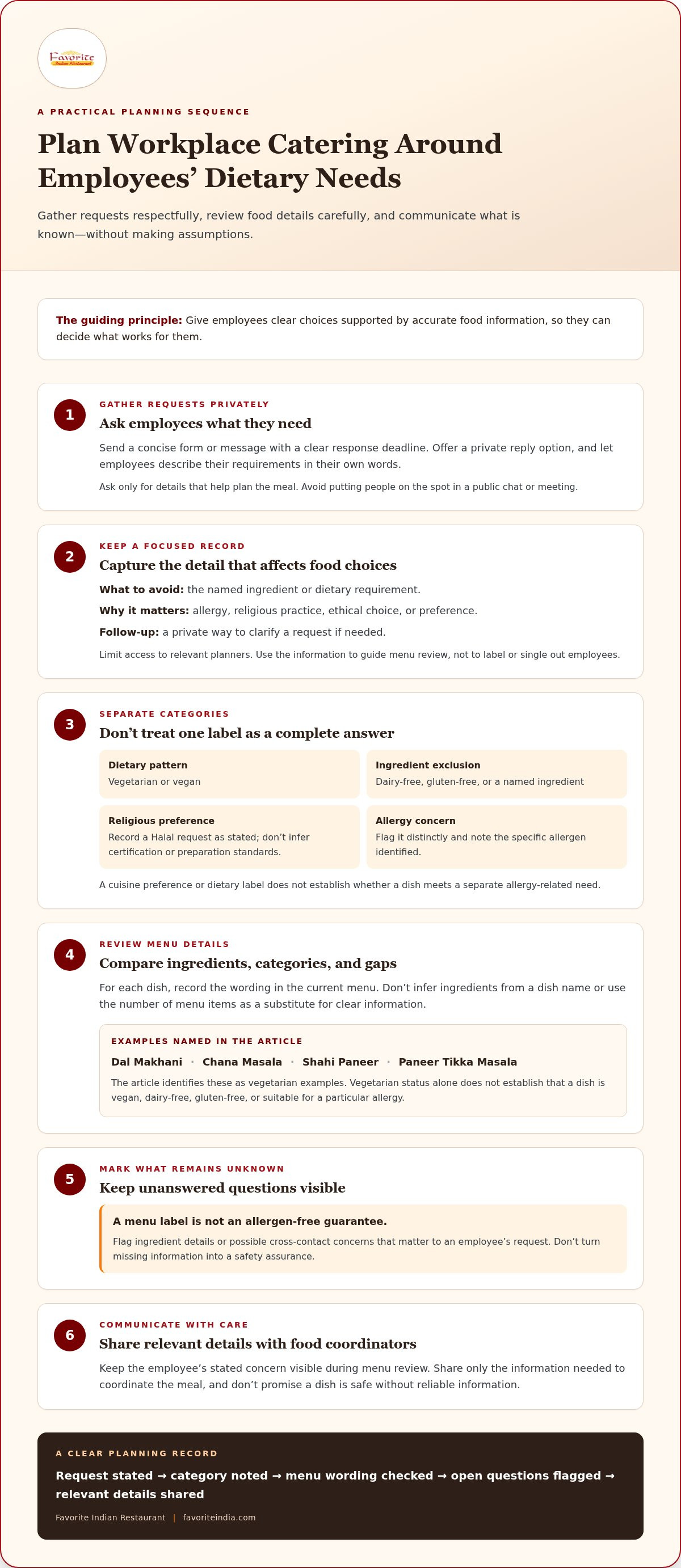
Gather needs, choose a format, review menu details, communicate choices, and prepare service in that order.
- Gather needs. Collect the headcount and relevant food requirements privately, keeping allergy-related requests distinct from general preferences.
- Choose a format. Consider the meeting schedule, available serving space, and how employees will select or receive their meals.
- Review menu details. Use the current catering menu to compare documented dishes with the needs employees shared, and note details that require clarification.
- Communicate choices. Share dish names and available ingredient information before the event, then make those details easy to find at service.
- Prepare service. Decide where food and labels will go, how meals will be identified, and who will handle event-day questions or changes.
What should the organizer share during planning?
Give the caterer a useful picture of the event: headcount, setting, preferred service format, and the dietary requirements employees shared. Keep allergy information specific and separate from preferences such as spice level or cuisine. Use the Favorite Indian Restaurant catering menu to review documented dishes, and note ingredient questions that matter to the requests received.
How should dietary information reach employees on event day?
At the serving point, display dish names alongside the ingredient information available for each selection. Tell employees where to find those details, whether on signs or in a shared event note, without making safety guarantees. Assign one event contact to manage logistics, relay updates, and direct questions to the appropriate person. Clear communication helps employees make informed choices without having to explain their needs publicly.
For an office gathering in Hayward or an East Bay function, plan the room and meal flow together. Allow space for employees to approach the food, read labels, and collect their selections without confusion. Keep the event contact informed if the setup or menu changes, so the information shared with attendees stays aligned with what is being served.
Favorite Indian Restaurant provides Indian food catering for corporate events and other private and public functions. To plan a workplace meal around your event’s needs, explore catering with Favorite Indian Restaurant.
Choose Favorite Indian Restaurant Catering for an East Bay Workplace Meal
For a workplace gathering in Hayward or elsewhere in the East Bay, Favorite Indian Restaurant brings Punjabi and North Indian cuisine to corporate events and other private and public functions. Its Indian food catering gives a team meal a distinctive regional character, with curries and vegetarian choices that add variety to the table.
Planning still starts with the people attending. Use the dietary requests your team has shared to review dish descriptions and available ingredient information, rather than assuming a cuisine or menu category suits everyone. That thoughtful comparison helps organizers consider Indian food as an appealing option for catering for employees with dietary restrictions, without presenting any menu as a universal fit.
What can a Punjabi and North Indian menu bring to a team meal?
Documented menu examples include Butter Chicken, Dal Makhani, Chana Masala, and paneer dishes such as Shahi Paneer. Tandoori specialties add another style of preparation to consider alongside curries. Together, these dishes bring different flavors and textures to a shared workplace meal. Their names and categories, however, don’t establish that every dish meets a particular allergy, vegan, dairy-free, or other requirement.
Favorite Indian Restaurant identifies as a provider of Halal Indian food. Organizers should represent that accurately and avoid inferring certification or specific preparation standards from the description. As with other dietary needs, employees benefit from clear, dish-specific information when making their choices.
How can East Bay organizers take the next step?
Favorite Indian Restaurant is located in Hayward and serves the East Bay, making it a local catering option for workplace events in the area. Organizers can use the Indian catering menu to consider dishes alongside their event format and team’s stated needs. Keep unanswered ingredient or dietary questions visible in the planning notes rather than filling gaps with assumptions.
For local workplace planners in Ashland, Fairview, Cherryland, Hayward, Castro Valley, Union City, Fremont, San Leandro, San Lorenzo, San Ramon, Oakland, Dublin, Pleasanton, San Francisco, Livermore, Milpitas, and San Jose, the same planning basics apply: match the meal format to the event and make available dish information easy to find.
Before the event, align the planned menu with how employees will select and receive their food. Share dish names and available information clearly, and make it easy for attendees to find those details. This follow-through keeps the meal welcoming while respecting that each person makes choices based on their own needs.
For a workplace gathering in Hayward or an East Bay event, explore catering for your workplace event with Favorite Indian Restaurant.
Make the Next Workplace Meal More Welcoming
A shared meal can do more than fill a break. It can help colleagues feel considered when choices are clearly presented and employees can decide what suits their needs. Treat each event as a chance to learn what made ordering and service comfortable, then carry those practical insights into your next gathering.
For catering for employees with dietary restrictions, thoughtful planning is a meaningful first step, not a promise that every dish will suit every person. Favorite Indian Restaurant has served the community since 1998 and brings its Punjabi and North Indian cuisine to workplace catering and events.
If you’re planning a gathering in Hayward or elsewhere in the East Bay, take the next step and explore the possibilities for your event. Explore catering for your workplace event with Favorite Indian Restaurant.
Frequently Asked Questions
How do you cater lunch for employees with different dietary restrictions?
Build the meal plan around individual requirements, then compare each selected dish with them. If one employee requests a vegan meal and another needs to avoid a particular ingredient, don’t assume one vegetarian dish addresses both needs. Keep a clear record for the organizer, match meals to employees if they’re individually selected, and make dish information easy to access during lunch.
What dietary restrictions should an office catering form ask about?
Ask employees to share the food information that will guide their meal choice: allergies, ingredients they need to avoid, vegetarian or vegan preferences, and religious dietary preferences such as Halal. Include a separate space for nonessential preferences, such as preferred spice level, so they aren’t confused with requirements. Offer a private way to respond, and avoid asking for diagnoses or other personal details the organizer doesn’t need.
Can Indian catering work for employees with dietary restrictions?
Yes. Indian catering can work for a mixed-diet group when each dish is evaluated against the requests received. Favorite Indian Restaurant’s documented options include Chana Masala, Dal Makhani, paneer dishes, and meat specialties such as Butter Chicken. A vegetarian dish isn’t automatically vegan or free of specific ingredients, so employees need accurate dish information to decide what fits their needs.
How should an employer handle food allergies at a catered lunch?
Handle an allergy request separately from a general preference. Record the specific allergen the employee identifies, communicate it to the event’s food planner, and make available ingredient information easy to find. Don’t label a dish allergen-free or promise it’s safe unless that information is reliable. Employees should be able to choose another option without pressure if they can’t determine whether a dish meets their needs.
Is a buffet or individually boxed meal better for a team with dietary restrictions?
Neither format is always better. Choose based on how employees will select food and how clearly the options can be identified. Individually selected meals can make it easier to match a planned choice to a person, but require organizing selections and distribution. A buffet offers visible variety, while employees rely on clear labels and accessible details. Consider the room, schedule, and serving flow before deciding.
Does Favorite Indian Restaurant provide catering for corporate events in Hayward?
Yes. Favorite Indian Restaurant is based in Hayward and provides Indian food catering for corporate events, as well as other private and public functions. Its cuisine specializes in Punjabi and North Indian food. The Indian catering menu is a useful starting point for reviewing documented dishes and considering them alongside employees’ stated meal requirements.